The basic minimum wage is €1,801.80 per month. The specific wage will vary according to the company’s collective labor agreement.
For employees hired under the EOR model, the following minimum wage standards apply:
Basic and junior positions: €2,704.80 per month
Administrative positions: €3,284.40 per month
Smart Deer’s collective labor agreement is Portage, and the minimum wage is subject to the social security ceiling.
Overtime Pay and Maximum Working Hours
The standard working hours are 7 hours per day and 35 hours per week. The standard working week is from Monday to Friday.
Part – time employees are entitled to overtime pay. Employees hired under the “day pass” contract terms are not entitled to overtime pay. Time outside the standard working hours is also considered overtime. Part – time employees can work up to one – tenth of the weekly working hours, but the pay is 110% of the hourly wage.
Personal Income Tax
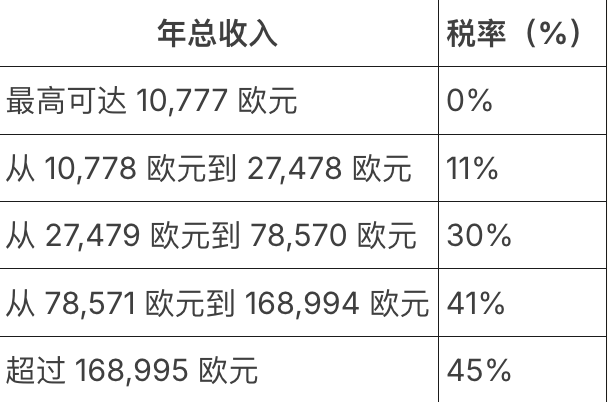
The personal income tax can reach up to 45%. The income tax is calculated using a progressive tax rate. In addition, various factors can affect the overall tax rate, such as family status and the number of children.
Statutory Holidays
Both full – time and part – time employees are entitled to 25 working days of paid time off (PTO) per year. PTO accumulates at a rate of 2.08 days per month. Unused PTO at the end of the leave year can be carried forward. Employees can carry forward unused leave indefinitely, and these leaves will expire on May 31 of the following year.
Employees cannot take 25 consecutive days off and should take at least 5 days off separately. Employees must take PTO between May 1 and October 31.
During this period, PTO should last at least 12 days and must be agreed upon with the employer.
Legal Holidays
France celebrates 11 national holidays and 2 regional holidays depending on the employee’s location.
National public holidays include:
New Year’s Day
Easter Monday
Labor Day
Ascension Day
Victory Day
Pentecost Monday
Bastille Day
Assumption of Mary
All Saints’ Day
Armistice Day in 1918
Christmas Day
Regional holidays:
Good Friday
St. Stephen’s Day
Other Leaves
Maternity Leave
Pregnant employees are entitled to 16 weeks of paid leave. Six weeks of this leave must be taken before the child’s birth. During this period, employees will receive the average salary of the three months before the leave, up to a maximum of €3,864. The employer is responsible for paying this amount, and the social security agency will reimburse it.
Employees cannot extend their leave, but if they have worked for the same employer for at least one year, they can apply for parental leave.
Paternity Leave
Employees are entitled to 25 calendar days of paid paternity leave. Four days of this leave must be taken after the child’s birth. The remaining leave can be divided into two periods, with each period being at least 5 days, until the child is six months old.
Employees will receive the average salary of the three months before the leave, with a maximum of €100.36 per day. During this period, the employer will be responsible for paying the paternity leave.
Employees cannot extend their leave, but if they have worked for the same employer for at least one year, they can apply for parental leave.
Parental Leave
Employees are entitled to up to one year of parental leave. Employees can choose to take full – time leave, and the contract will be suspended; or they can choose part – time leave, working at least 16 hours per week.
If the latter option is chosen, employees can choose their working hours, but they must reach an agreement with the employer. If employees take full – time leave, it is unpaid. If they take part – time leave, they will be paid proportionally.
Parental leave can be extended until the child is three years old.
Sick Leave
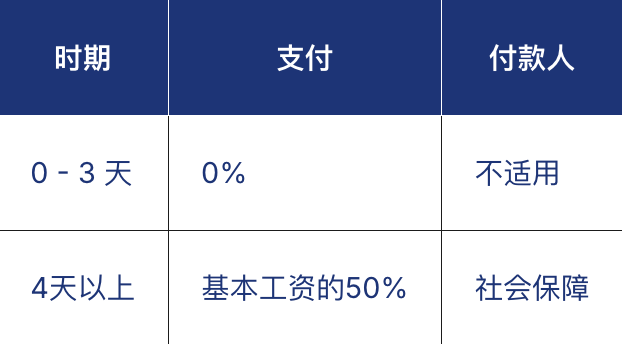
Employees are entitled to different lengths of sick leave and different salary standards, depending on their job category, length of service with the current employer, and the number of sick days. Sick pay is shared by the employer, the social security agency, and any applicable life insurance company.
Based on the above factors, the employer needs to pay 10% – 100% of the employee’s normal salary.
Employment Contract
The contract must be in French and can also be bilingual. The contract must be in writing and signed by both parties.
The contract must include:
Name
Start date
Length of service
Job description
Termination conditions
Collective bargaining agreement
Probationary Period
The maximum probationary period is 180 days; for executive positions, it is 240 days.
Employer Costs
Depending on the employee’s salary, a specific calculation method may be used. It is estimated that employer costs can be as high as over 50%.
Details of various tax rates:
Illness, maternity, disability, death:
If the salary is less than €4,442.25, the tax rate is 7.00%.
If the salary exceeds €4,442.25, the tax rate is 13%.
Supplementary incapacity for work, disability, death:
If the salary is less than €3,864, the tax rate is 0.89%.
For the part of the salary exceeding €3,864, an additional 1.450% is charged.
Work – related accidents – occupational diseases – 0.75%
Social security ceiling – 8.55%, with a maximum salary of €3,864
No social security ceiling – 2.02%
Family benefits:
If the salary is less than €6,219.15, the tax rate is 3.45%.
If the salary exceeds €6,219.15, the tax rate is 5.25%.
Unemployment insurance – The contribution amount is 4.20% of the maximum salary, with a maximum amount of €15,456.
Pension:
If the salary is less than €3,864, the tax rate is 6.26%.
Plus 14.82% of the part of the salary exceeding €3,864 up to €32,944.
Other contributions* – 2.906%
Housing subsidy FNAL – 0.10%, with a maximum salary of €3,864
Occupational medicine – When the salary exceeds €3,864, the tax rate is 0.41% + a fixed fee of €9.53
Surcharge for fixed – term contracts – 1%
Supplementary medical benefits – €68.73 (estimated)
Medical visit fee – €4.90
Mandatory electronic safe deposit fee – €3.46
Time – tracking software fee – €3.00
*Other contributions include the following:
Apprenticeship tax – A tax aimed at promoting equal apprenticeship opportunities and the development of apprenticeship programs.
Training tax – A tax used to support continuous training programs for employees and job seekers.
Egalitarian development – Funding for employee unions and professional employer organizations.
Please note that according to the collective bargaining agreement, the mandatory business allowance cost is 5% of the employee’s salary. The salary used to calculate the cost includes the total monthly salary + 5% of the mandatory business allowance.
Annual costs:
Annual medical fee – €50
Termination (Legal Requirements and Best Practices)
Notice Period
The notice period varies depending on multiple factors and needs to be evaluated on a case – by – case basis. Payment in lieu of notice and garden leave are permitted.
Termination for Incapacity
Definition: When an employee is unable to continue performing their job duties due to medical or health reasons, the employer has the right to terminate the employment contract in accordance with the law.
Applicable situations:
Loss of medical capacity due to work – related accidents or occupational diseases.
Loss of medical capacity due to non – work – related accidents or illnesses.
Compliance requirements:
This type of termination must be based on a formal procedure, and a statement from an occupational doctor must be obtained, proving that continued employment will have an adverse impact on the employee’s health, or the employee’s health condition hinders reasonable job adjustments.
The employer must prove that it is unable to arrange a suitable job adjustment for the employee, or the employee has refused a reasonable job transfer arrangement.
Statutory notice period: No prior notice is required after completing the formal procedure.
Severance pay:
Non – work – related incapacity:
For the first 10 years of service, one – quarter of the monthly salary is paid as severance pay for each year of service.
After more than 10 years of service, one – third of the monthly salary is paid as severance pay for each year of service.
Work – related incapacity (due to occupational injury or disease): The severance pay is twice that of non – work – related incapacity.
Final payment time: All due payments should be made on the day of the employment contract termination; however, case law allows the employer to make the final payment within the normal payroll cycle of the current month.
Termination for Non – Disciplinary Reasons
Definition: It refers to the situation where the employer terminates the employment contract in accordance with the law due to the employee’s poor performance or lack of professional ability.
Applicable reasons:
Employees are unable to perform their job duties for a long time due to reasons such as qualifications and abilities, and their performance is sub – standard.
Employees’ lack of professional ability or negligence leads to the failure to achieve reasonable goals in line with the company’s market situation.
Note: Termination should not be based on disciplinary negligence. It must be based on specific, objective, and verifiable facts, and these facts should be attributed to the employee themselves.
Compliance requirements:
The reason for termination must comply with the law and be legal and reasonable.
The employer must initiate and complete a formal procedure, including:
Formally notifying the employee of the reason for termination.
Explaining the reason for termination.
Giving the employee an opportunity to defend themselves.
Statutory notice period: The notice period varies depending on the employee’s length of service, the terms of the employment contract, and the reason for termination. Smart Deer’s legal team will evaluate each case and confirm the applicable notice period.
Severance pay: Severance pay is legally required, and the specific amount is determined according to the applicable collective labor agreement.
Other due payments:
All accumulated and unused paid leave of the employee.
Other applicable benefits (such as réserve financière).
Final payment time: All due payments should be made on the day of the employment contract termination; however, case law allows the employer to make the payment within the normal payroll cycle of the current month.
Employee notification method: Employees should be formally notified by registered mail or electronic registered mail (AR24) of the French postal service.
Resignation
Definition: Employees have the right to resign at any time and terminate the employment contract relationship.
Compliance requirements: Employees must notify the employer of their intention to resign in advance according to their employment contract and any applicable collective labor agreement.
Statutory notice period:
According to the employment contract or collective agreement, it is usually:
ETAM employees (general staff): One – month notice is required regardless of seniority.
Executives: Three – month notice is required regardless of seniority.
The employer has the right to waive the employee’s notice period.
Severance pay: There is no legal obligation to pay severance pay.
Other due payments: Employees are entitled to their accumulated Réserve financière (reserve funds).
Final payment time: All due payments should be settled on the day of the employment contract termination; however, according to case law, the employer can choose to pay the final amount within the normal payroll cycle of the current month.
Employee notification method: The resignation notice should be formally served by registered mail or electronic registered mail (AR24) of the French postal service.
Mutual Termination
Definition: Mutual termination refers to the situation where the employer and the employee voluntarily reach an agreement to terminate the employment contract for any reason. In France, this method also applies to situations such as business needs or layoffs.
Local term: In French, it is called Rupture conventionnelle.
Common applicable situations:
There may be disputes or litigation risks with the employee.
The employee is not suitable to be terminated for disciplinary or non – disciplinary reasons.
The employee has reached an agreement with the customer and chooses mutual termination.
Compliance requirements:
A formal procedure must be followed, and approval from the Regional Directorate for Enterprises, Competition, Consumption, Labor and Employment (DREETS) must be obtained.
The time limits and procedures stipulated by the law must be strictly followed.
From the signing date of the termination agreement to the contract termination date, the entire process takes about 35 days, during which the employee continues to receive their normal salary (including the time for prior summons and negotiation).
Statutory notice period: No additional notice is required, but the entire termination process lasts at least 35 days, and the salary and related employment costs must be paid normally during this period.
Severance pay:
The law and collective agreements stipulate a minimum compensation standard: At least one – quarter of the monthly salary is paid as compensation for each year of service.
Due to the complexity of the process, the two parties often negotiate the compensation amount, which is usually higher than the minimum standard.
After the agreement is signed, either party has a 15 – day cooling – off period to revoke the agreement without reason, so the final compensation often includes additional compensation.
Other due payments:
The employee’s full salary is paid during the entire process, including about 40 – 45% of social security and employment costs.
All unused paid leave and RTT (reduced working time leave) are settled.
Ensure that the statutory minimum compensation amount (1/4 monthly salary/year of service) is paid.
Social security fee explanation:
The statutory minimum compensation amount (1/4 monthly salary/year of service) is exempt from social security contributions.
The part exceeding the minimum compensation is subject to about 30% social security contributions.
Final payment time: All due payments should be made on the day of the employment contract termination; however, case law allows the employer to pay the final amount within the normal payroll cycle of the current month.
Termination During Probation Period
Definition: During the probation period, either the employer or the employee can terminate the employment contract at any time and end the employment relationship.
Reason for termination: Termination during the probation period does not need to meet specific legal reasons.
Compliance requirements:
There are the following special restrictions on termination during the probation period:
The termination target cannot be a protected employee (for example, an employee representative elected by the trade union needs to obtain approval from the labor inspection department before termination).
An employee cannot be terminated due to work – related injuries or occupational diseases, unless it is due to serious disciplinary violations or reasonable reasons unrelated to the illness.
Termination cannot be based on discriminatory reasons, including sick leave or pregnancy.
Statutory notice period:
Employer’s notice period for termination:
Less than 8 days of work: 24 – hour notice in advance.
8 days to 1 month of work: 48 – hour notice in advance.
1 to 3 months of work: 2 – week notice in advance.
More than 3 months of work: 1 – month notice in advance.
Employee’s notice period for termination:
Less than 8 days of work: 24 – hour notice in advance.
More than 8 days of work: 48 – hour notice in advance.
Severance pay: There is no legal obligation to pay severance pay.
Other due payments:
Accumulated and unused paid leave.
The employee’s reserve funds (Réserve financière).
Notification method: Employees should be formally notified by registered mail or electronic registered mail (AR24) of the French postal service.
Termination for Disciplinary Reasons
Definition: It refers to the situation where the employer terminates the employment contract in accordance with the law due to the employee’s improper behavior.
Applicable situations:
Gross Misconduct: Including but not limited to long – term absenteeism without just cause, frequent short – term absenteeism, violent behavior, threats, workplace bullying, financial misconduct, refusal to perform work duties, etc.
Serious Misconduct: Such as repeated minor negligence, work negligence, refusal to accept reasonable work condition adjustments, etc.
Usually, lack of professional ability or poor performance does not constitute a legal reason for disciplinary termination, unless it can be clearly proven that the performance is due to the employee’s intentional absenteeism or other improper behavior.
Compliance requirements:
The reason for termination must comply with the law and be legal and reasonable.
The employment contract cannot be terminated based on suspicion or subjective judgment. Specific evidence and written records must be provided to withstand scrutiny.
The employer needs to follow a formal disciplinary procedure, including:
Informing the employee of the specific reason for terminating the employment contract.
Giving the employee an opportunity to defend themselves.
The disciplinary procedure must be initiated within two months from the discovery of the facts that can be used as the basis for termination. Once relevant facts are discovered, please immediately notify Smart Deer for legal review.
Statutory notice period: The notice period is determined based on multiple factors, including the employee’s length of service, the terms of the employment contract, and the reason for termination. Smart Deer’s legal team will evaluate each case and confirm the applicable notice period.
Severance pay: There is no mandatory legal requirement to pay severance pay, unless the applicable collective agreement stipulates otherwise.
Other due payments:
All accumulated but unused paid annual leave.
If applicable, other benefits stipulated in the employee’s collective agreement (such as Réserve financière).
Final payment time: In principle, all due payments should be settled on the day of the employment contract termination; however, according to case law, the employer can choose to complete the payment within the normal payroll cycle of the current month.
Employee notification method: Employees should be formally notified by registered mail or R24 (electronic registered mail) of the French postal service.