Overtime payment: There is no legal requirement. Overtime pay is determined by the employer.
Standard working hours: 8 hours per day, 40 hours per week. The standard working week is from Monday to Friday.
Definition of overtime: Working hours outside the standard working hours are considered overtime.
Maximum working hours: There is no legal upper limit.
Personal Income Tax
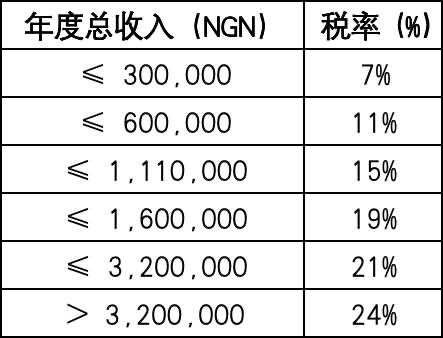
Tax rates are calculated on a graded basis according to the annual total income, ranging from 7% to 24%.
Statutory Holidays
Paid Time Off (PTO)
Full – time employees: Entitled to 6 days of paid leave per year.
Accumulated monthly: 0.5 days per month.
Employees must work continuously for 12 months before they can use their annual leave.
Full – time employees under 16 years old: Entitled to 12 days of paid leave per year.
Statutory Public Holidays
National public holidays (10 days):
New Year’s Day
Good Friday
Easter Monday
Worker’s Day
Sallah National Holiday (2 days)
Democracy Day
Id el Kabir / Feast of Sacrifice
Independence Day
Christmas Day
Boxing Day
Regional public holidays (2 days):
Anambra State public holiday
Borno State Sambisa Memorial Day
Other Leaves
Maternity Leave
Applicable to: Pregnant employees who have worked continuously for 6 months or more.
Leave period: A total of 12 weeks of paid maternity leave, including 6 weeks before delivery and 6 weeks after delivery.
Salary payment: Employees are entitled to at least 50% of their salary during maternity leave, paid by the employer.
Extension: If an extension is required due to illness, a certificate from a registered doctor is needed.
Paternity Leave
Legal requirement: There is currently no legal requirement in Nigeria for paternity leave.
Parental Leave
Nigerian law does not regulate parental leave.
Employees mainly enjoy maternity leave, and paternity leave can be provided according to the company’s policy.
Sick Leave
Applicable to: All employees.
Leave days: Up to 12 days of paid sick leave.
Condition: A certificate of illness from a registered doctor is required.
Salary payment: Employees are entitled to 100% of their basic salary during sick leave, paid by the employer.
Employment Contract
Contract requirements:
The contract must be in written form, either in English or bilingual. It must be signed by both the employer and the employee.
Contract contents should include:
Employee’s name
Start date
Duties and responsibilities
Working hours
Compensation and other benefits
Termination conditions
Probation period
Probation Period
For employees hired through the SmartDeer platform, the probation period is 90 days, which can be extended to 180 days.
Since January 2022, SmartDeer’s company policy requires that all new employment contracts include a probation – period clause.
Purpose:
To help the employer and the employee assess their suitability for each other.
For the company to quickly decide whether to continue the employment.
For the employee to judge whether the position meets their career development goals.
Employer Costs
Employer costs are usually about 12% of the employee’s salary, mainly including:
Industrial Training Fund: 1.10%
Nigeria Social Insurance Trust Fund (NSITF): 1.0%
Pension Fund: 10.0%
Group Life Insurance (GPA): 1.8%
Note: The above are estimated values for reference only. For a comprehensive understanding of all costs and fees related to Nigerian employment agreements, please contact the sales team for a quote.
Termination (Legal Requirements and Best Practices)
Notice Period
Legal requirements:
Notice for termination during the probation period: 1 week.
Notice for termination after the probation period:
Less than 3 months of service: 1 day.
3 months to 2 years of service: 1 week.
2 to 5 years of service: 2 weeks.
More than 5 years of service: 1 month.
Payment in lieu: Allowed.
Garden Leave: Allowed.
Local best practices:
Implement the notice period as required by law.
Payment in lieu is common and acceptable.
Garden Leave is also a common practice.
Termination With Cause
Concept explanation:
“Termination with cause” means that the employer can immediately terminate the employment relationship without serving the notice period due to the employee’s serious negligence or major breach of contract. However, it should be noted that:
“Immediate termination” does not mean skipping the procedures. A compliant disciplinary investigation and hearing process must still be carried out.
“Immediate” only means not having to pay the notice – period salary (summary termination).
This type of termination only applies to extremely serious special circumstances.
Applicable situations:
Gross Misconduct:
Including but not limited to:
Theft, fraud
Physical assault, violent behavior
Deliberate disobedience of management instructions
Sexual harassment
Other behaviors that seriously damage the employment trust relationship
Continued Poor Performance:
The employee continuously fails to meet the performance requirements.
There is still no improvement after multiple warnings and opportunities for improvement.
Breach of Contract:
For example:
Disclosure of confidential information
Competitive behavior with the company
Other major contract breaches
Compliance requirements:
The employer must:
Conduct a comprehensive investigation: Collect evidence and confirm the facts.
Give the employee an opportunity to defend themselves: Such as a disciplinary hearing, allowing the employee to respond to the accusations.
If the decision to terminate is made: Issue a written termination notice clearly stating the reasons and basis for termination.
Legal notice period:
Implement according to the employment contract.
In the case of termination with cause, there is no need to pay the notice – period salary.
Severance: There is no legal requirement to pay severance.
Final payment due: For employees paid on a monthly basis, all due payments must be settled within 30 days after the termination date.
How to notify the employee: A written termination notice must be issued, clearly stating the reasons for termination. It can be delivered in the following ways:
Handed to the employee in person.
Sent by registered mail to the employee’s last registered address (with a return receipt confirmation).
Termination for Redundancy or Other Business Reasons
Concept explanation:
Due to reasons such as company operations, financial or structural adjustments, the employer can terminate the employee’s employment relationship based on redundancy or other business needs.
Applicable situations:
Termination can be based on the following business reasons:
Company restructuring
Downsizing
Closing part or all of the business
Technological upgrading making the position no longer needed
Economic difficulties making the company unable to maintain the existing staff size
Compliance requirements:
The employer generally needs to fulfill the following obligations:
Conduct employee consultation: Before making the final termination decision, full and effective communication should be carried out with the affected employees or their representatives. The purposes include:
Exploring alternative solutions
Mitigating the impact
Allowing employees to express their opinions and concerns
Set fair and objective selection criteria: To determine which positions or employees will be affected by the redundancy, avoiding discrimination and subjective judgment.
Keep complete documentation: Including:
Consultation records
Employee selection criteria
Evaluation records of other alternative solutions
Legal notice period:
If the contract does not specify a longer notice period, the legal minimum standard is:
Less than or equal to 3 months of service: 1 day.
More than 3 months but less than 2 years of service: 1 week.
2 to 5 years of service: 2 weeks.
More than or equal to 5 years of service: 1 month.
Severance:
There is no fixed legal standard amount.
Both parties must negotiate the severance, and the amount is determined by the negotiation.
Final payment due: All due payments must be made within 30 days after the termination date.
How to notify the employee:
The employee must be notified in writing.
The content should include:
Reasons for termination
Effective date
Explanation of the final salary and other payments
Delivery methods can be:
Handed in person
Sent by registered mail to the employee’s last registered address (with receipt confirmation)
Resignation
Concept explanation: Employees can voluntarily resign at any time according to the terms of the employment contract.
Applicable situations:
There are no specific legal requirements.
Employees can decide the reasons for resignation on their own.
Compliance requirements: Employees need to submit a written resignation letter clearly stating the effective resignation date.
Legal notice period: Usually 1 month, or as stipulated in the employment contract.
Severance: There is no legal requirement to pay severance.
Final payment due: The employer must pay all due payments to the employee within 30 days after the effective resignation date.
Mutual Termination
Concept explanation: Mutual termination means that the employer and the employee voluntarily and unanimously agree to terminate the employment relationship through negotiation, without being restricted by specific reasons.
Common reasons:
The employee may pose a risk of dispute or litigation, and both parties hope to end the relationship smoothly through an agreement.
The employee does not meet the conditions for “termination with cause” or “termination for redundancy or other business reasons” and cannot be terminated in other ways.
The employee initiates and negotiates a mutually agreed – upon separation plan.
Notice period: Determined by both parties through negotiation and does not have to follow the legal or contractual provisions.
Severance: Severance must be paid for mutual termination, and the amount is determined by both parties through negotiation.
Final payment due: The payment time is determined by both parties through negotiation and can be clearly stipulated in the agreement.
Termination During Probation Period
Concept explanation: During the probation period, either the employer or the employee can terminate the employment relationship at any time.
Applicable situations:
Including but not limited to:
Poor work performance
Inability to meet the job requirements
Incompatibility with the company culture or team atmosphere
Other reasonable reasons
Compliance requirements: There are no specific legal procedural requirements.
Notice period:
Implement according to the employment contract.
Usually 1 week.
Severance: There is no legal requirement to pay severance.
Final payment due: All due payments must be made within 30 days after the termination date.
How to notify the employee: A written notice must be provided, clearly stating the effective termination date.