
Monthly Minimum Wage
Starting from January 2025, the monthly minimum wage is 26,005.5 TL (before tax).
Overtime Pay and Maximum Working Hours
- Paying overtime pay is mandatory.
- There is no hard requirement for the daily overtime hours to be 2 hours. The cumulative overtime cannot exceed 45 hours per week and 270 hours per year.
- For overtime work on weekdays (including Saturdays), employees’ wages are 1.5 times the hourly wage on weekdays. On weekends (Sundays and legal holidays), employees’ wages are twice the hourly wage on weekdays.
- The standard working hours are 9 hours per day, 5 days a week (it can also be arranged on Saturdays, provided that the total working hours do not exceed 45 hours per week). The total working hours per week cannot exceed 45 hours.
Personal Income Tax
The scope of personal income tax collection ranges from 15% to 40%, calculated on a progressive basis.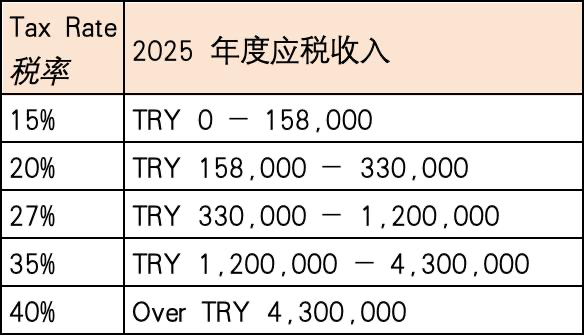
Statutory Annual Leave
- For employees with 1 – 5 years of service, the annual leave is 14 days.
- For employees with more than 5 years of service, the annual leave is 20 days.
- For employees with more than 15 years of service, the annual leave is 26 days.
There is no limit on carrying over annual leave. The leave can expire or be paid.
Statutory Holidays
Turkey celebrates 9 national holidays in total. The national public holidays include: New Year’s Day; National Sovereignty and Children’s Day; Labor Day; Atatürk Memorial and Youth Day; Democracy and National Unity Day; Victory Day; Republic Day; Eid al – Fitr; Eid al – Adha.
Other Leaves
- Maternity Leave
- Leave duration: 16 weeks of paid maternity leave (8 weeks before birth; 8 weeks after birth).
- Salary payment: During maternity leave, employees are paid two – thirds of their salary (66.67%). The payment is the responsibility of the Social Security Institution (SGK), provided that the employee has paid SGK premiums for at least 90 days in the past 12 months and does not exceed the SGK premium ceiling.
- Nursing time: From 8 weeks after giving birth until the child reaches 1 year of age, the employee is entitled to 1.5 hours of nursing time per day, which can be accumulated.
- Extended leave: Employees can extend their maternity leave, but they will not receive salary and do not need to submit a medical certificate.
- Paternity Leave
- Employees are entitled to 5 days of paid paternity leave, which must be taken after the child is born. During this period, employees will receive 100% of their salary, and the employer is responsible for the payment.
- Legally, employees have no right to extend paternity leave. Whether to allow the extension depends on the employer’s discretion.
- Sick Leave
- According to the law, the SGK pays 33.3% of the sick – leave salary, and the company can decide whether to pay the remaining 66.7%.
- Employees are entitled to 1 week of paid sick leave. Sick leave can be extended, but the extended period is unpaid.
Employment Contract
- One – year contracts are only applicable to foreign labor. Local employees cannot sign one – year contracts and can only sign open – ended contracts.
- The contract must be in Turkish and can be bilingual. The contract must be in written form and signed by both parties.
- The contract must include the following contents: name; date of employment; employment period; working hours; job description; salary and benefits; conditions for terminating the contract.
It is recommended to have a one – year or open – ended contract.
Probation Period
It does not exceed 60 days.
Employer Costs
- Universal Health Insurance (7.5%)
- This is a statutory contribution to public health insurance, calculated based on the employee’s monthly salary. The maximum salary in 2025 is 195,041.40 TL.
- Long – term Insurance Branch Premium (11%)
- This part of the social security contribution funds long – term social insurance benefits such as retirement, disability, and survivor benefits. It is also calculated based on the employee’s monthly salary, with the same maximum salary limit.
- Short – term Insurance Branch Premium (2%)
- This contribution funds short – term social insurance benefits, including temporary disability, maternity, and work – related injury or illness insurance. This benefit is calculated similarly based on the employee’s monthly salary, with the same maximum salary limit.
- Social Security Institution (SSI) Incentive (-5%)
- This is an employer cost reduction applicable when social security contributions are paid on time. It is calculated based on the employee’s monthly salary, with the same maximum salary limit.
- Unemployment Insurance (2%)
- This contribution is used for the unemployment insurance fund and is calculated based on the employee’s monthly salary, with the same maximum salary limit.
The total of these contributions is 17.5% of the employee’s monthly salary, but there is a ceiling.
- This contribution is used for the unemployment insurance fund and is calculated based on the employee’s monthly salary, with the same maximum salary limit.
Termination (Legal Requirements and Best Practices)
- Notice Period
- For employees with less than 6 months of service: 2 weeks.
- For employees with 6 months to 1.5 years of service: 4 weeks.
- For employees with 1.5 to 3 years of service: 6 weeks.
- For employees with 3 years or more of service: 8 weeks.
- Termination With Just Cause
- Definition: Allows the employer to immediately terminate the employee without prior notice due to serious misconduct or other justifiable reasons.
- Reasons for termination: Serious misconduct, dishonorable, immoral or malicious behavior, or any serious violation of the employment contract, company policy or applicable law; slandering the employer; dishonesty, stealing company funds or property; forging records; harassment; violence; unauthorized absence; employee being detained or arrested; incapacity for work due to health reasons caused by the employee’s own intentional actions; force majeure.
- Compliance requirements: The employer must follow a disciplinary procedure before termination. The employer must inform the employee of the reasons for termination in writing and must be able to prove the reasons beyond reasonable doubt. The employee must be given an opportunity to defend themselves. If the employee fails to successfully defend themselves, a formal termination notice must be issued, clearly stating the reasons for termination.
- Statutory notice period: If the reasons can be proven beyond reasonable doubt, no prior notice is required.
- Severance pay:
- If the termination is due to health reasons, force majeure or the employee being detained/arrested, the employer must pay all unpaid labor remuneration (such as overtime pay, annual leave or statutory holiday pay). Employees with 1 year or more of service are entitled to severance pay, calculated as 1 month of pre – tax salary for each full year of service. Employees can also apply for unemployment benefits. The severance pay ceiling is 41,828.42 Turkish Lira (as of July 1, 2024).
- If the termination is due to reasons such as immoral, dishonorable or malicious behavior, the employer still needs to pay all unpaid labor remuneration (such as overtime pay, annual leave pay), but does not need to pay severance pay, and the employee has no right to apply for unemployment benefits.
- Final payment: All payable amounts must be settled within the salary payment cycle of the month of termination.
- Notice method: A written notice is sufficient, and a simple electronic signature (such as Dropbox Sign) can be used.
- Termination for Valid Reasons
- Definition: Allows the employer to terminate the employee for valid reasons.
- Reasons for termination: Loss of trust; poor work performance; inappropriate behavior.
- Compliance requirements: Before termination, the employee must be given an opportunity to defend against the accusations. The employer must provide the employee with a written termination notice, clearly and accurately listing the reasons for termination. Only after receiving the employee’s written defense can the employer formally terminate the employment contract through a written notice.
- Statutory notice period: It depends on the length of service as stipulated in the employment contract. For employees with less than 6 months of service: 2 weeks’ notice period; for employees with 6 months to 1.5 years of service: 4 weeks’ notice period; for employees with 1.5 to 3 years of service: 6 weeks’ notice period; for employees with more than 3 years of service: 8 weeks’ notice period. The notice period can be replaced by the employer paying an amount equivalent to the notice – period salary.
- Severance pay: Employees with 1 year or more of service must be paid severance pay, calculated as 1 month of pre – tax salary for each full year of service. The employer also needs to pay all unpaid labor remuneration (such as overtime pay, annual leave pay, statutory holiday pay). The severance pay ceiling is 41,828.42 Turkish Lira (as of July 1, 2024).
- Final payment: All payable amounts must be settled within the salary payment cycle of the month of termination.
- Notice method: A written notice can be used, and a simple electronic signature (such as Dropbox Sign) can be used.
- Resignation
- Definition: Allows the employee to resign at any time.
- Reasons for resignation: There is no legal requirement.
- Compliance requirements: The employee must submit a written and signed resignation letter (which can be submitted by email). The resignation letter must comply with the notice period agreed in the employment contract (Employment Agreement, EA).
- Statutory notice period: It varies depending on the length of service, usually as stipulated in the employment contract. For employees with less than 6 months of service: 2 weeks’ notice period; for employees with 6 months to 1.5 years of service: 4 weeks’ notice period; for employees with 1.5 to 3 years of service: 6 weeks’ notice period; for employees with more than 3 years of service: 8 weeks’ notice period.
- Severance pay: There is no legal requirement.
- Final payment: All payable amounts must be settled within the salary payment cycle of the month when the resignation occurs.
Note: Employees hired through SmartDeer EOR can submit their resignation letters in English.
- Mutual Termination
- Definition: Allows the employer and the employee to terminate the employment relationship by mutual agreement for any reason.
- Common reasons: The employee may be controversial or prone to litigation; the employee cannot be terminated through “termination with cause” or “layoff/other business reasons”; the employee actively negotiates a mutual termination.
- Statutory notice period: Determined by mutual negotiation.
- Severance pay: It must be paid, and the amount must be higher than the legal minimum standard. If the mutual termination agreement is signed without additional compensation, the court may deem the agreement invalid. In Turkey, the common practice is to provide 2 – 6 months’ salary as compensation. In addition, if the employee has served for more than 1 year, the employer also needs to pay the converted annual – leave salary and statutory severance pay.
- Final payment: All payable amounts must be settled within the salary payment cycle of the month of termination.
- Termination During Probation Period
- Definition: Allows the employer or the employee to terminate the employment relationship at any time during the probation period.
- Reasons: There is no mandatory requirement, but common reasons include poor work performance; inappropriate behavior; frequent lateness or absence.
- Compliance requirements: There are no legal requirements.
- Notice period: There are no legal requirements.
- Severance pay: There are no legal requirements.
- Final payment: All payable amounts must be settled within the salary payment cycle of the month of termination.
- Notice method: There are no legal requirements.