(a) Full – time: Fixed – term contracts / Open – ended contracts; (b) Part – time/Interns: Contracts must be in Polish, and bilingual contracts are also acceptable. Contracts must be in written form and signed by both parties.
Contracts must include: Total monthly salary; Salary payment deadline; Termination and notice period; Working hours; Agreement term (fixed – term/indefinite); Start date; Work location; Position.
Part – time Employees: IC Contracts
2. Overview of Local Statutory Welfare Systems
Salary Payment
Monthly Minimum Wage: As of January 1, 2025, the minimum wage is 4,666 zlotys per month and 30.50 zlotys per hour.
Probation Period: The probation period is not mandatory. There is no minimum probation period limit. The maximum probation period is 90 days (3 months).
Employer Costs: Employer costs are generally estimated to be 19.48% of the employee’s salary.
Pre – employment medical expenses – 200 Polish zlotys
Pension – 9.76%*
Disability – 6.50%*
Accident – 0.67%
Labor Fund – 2.45%
Guaranteed Employee Welfare Fund – 0.10%
PPK – 1.50% (mandatory if the employee chooses to join)
Remote work allowance – 100 Polish zlotys
PFRON – The amount varies monthly
*The maximum annual salary is 260,190 Polish zlotys
3. Salary Payment and Statutory Holiday Responsibilities
Personal Income Tax: Tax rates are calculated based on income according to the tax rates set by the Polish government.
There are two tax rates: The basic tax rate is 12% for a maximum of 120,000 Polish zlotys; The excess tax rate is 32% for all income above 120,000 Polish zlotys.
All Polish taxpayers are eligible for a tax – free allowance of 30,000 Polish zlotys. This tax – free allowance is granted in the form of a tax reduction of 3,600 Polish zlotys (300 Polish zlotys per month).
An additional 4% solidarity tax on high – income is levied on income exceeding 1 million Polish zlotys.
Overtime Pay and Maximum Working Hours: Overtime pay is mandatory. Time outside standard working hours is also considered overtime. Employees can work a maximum of 5 hours of overtime per day. Employees can work a maximum of 48 hours of overtime per week and 150 hours of overtime per year.
For additional working hours, employees will receive the following additional compensation:
For night shifts, Sundays and public holidays (non – working days for employees), non – working days (make – up days for Sundays or public holidays), and each hour exceeding the standard weekly working hours, employees will receive 100% of the hourly wage.
For overtime on days different from those mentioned above, employees will receive 50% of the hourly wage for each overtime hour.
According to company regulations, employees will receive 20% of the minimum hourly wage for each hour of night work.
Statutory Holidays: Full – time employees are entitled to paid time off (PTO) based on their seniority:
Employees with less than 10 years of work experience – 20 days of paid leave per year.
Employees with more than 10 years of work experience – 26 days of paid leave per year.
Note: University education counts as 8 years of work experience. Therefore, newly – hired employees with at least 2 years of work experience and a university degree are eligible for 26 days of paid leave per year.
If an employee is entitled to 20 days of paid leave, they will accumulate 1.6 days per month; if an employee is entitled to 26 days of paid leave, they will accumulate 2.16 days per month. Employees are eligible for annual leave after working for one month. Part – time employees are entitled to the same amount of paid leave as full – time employees, but it is calculated based on the proportion of their working hours.
Treatment or Conversion Logic of Unused Annual Leave at the End of the Year
National Holidays: There are 13 national holidays in Poland. National statutory holidays include:
New Year’s Day; Epiphany; Easter; Easter Monday; Labor Day; Constitution Day; Pentecost; Corpus Christi; Assumption of Mary; All Saints’ Day; Independence Day; Christmas; Boxing Day.
Other Holidays
Maternity Leave: Pregnant employees are entitled to 20 weeks of paid maternity leave. After 14 weeks, the mother can transfer the remaining leave to the father for a maximum of 6 weeks. During this period, employees will receive 100% of their sick – leave allowance, and social security benefits will be paid directly to the employee or through the employer (on behalf of the employer). If the employee confirms within 21 days after the start of maternity leave, they can also receive 80% of their salary during maternity and parental leave. Maternity leave starts automatically from the day the child is born.
Having multiple children (e.g., twins) can extend maternity leave. Employees can use parental leave to extend maternity leave.
Paternity Leave: Employees are entitled to two weeks of paid paternity leave, which can be taken within two years after the child’s birth. Paternity leave can be taken in two installments. During this period, employees will receive full pay, which is paid by the Social Insurance Institution (ZUS).
Employees cannot extend their leave.
Parental Leave: Employees who give birth to a single child are entitled to 32 weeks of parental leave, and employees who give birth to multiple children are entitled to 34 weeks of parental leave. Parents can decide how to allocate the leave time. Either parent can take parental leave. The Social Insurance Institution (ZUS) will pay 100% of the average salary for the first 6 weeks and 60% of the average salary for the following weeks.
Parental leave can be used until the child reaches the age of 6.
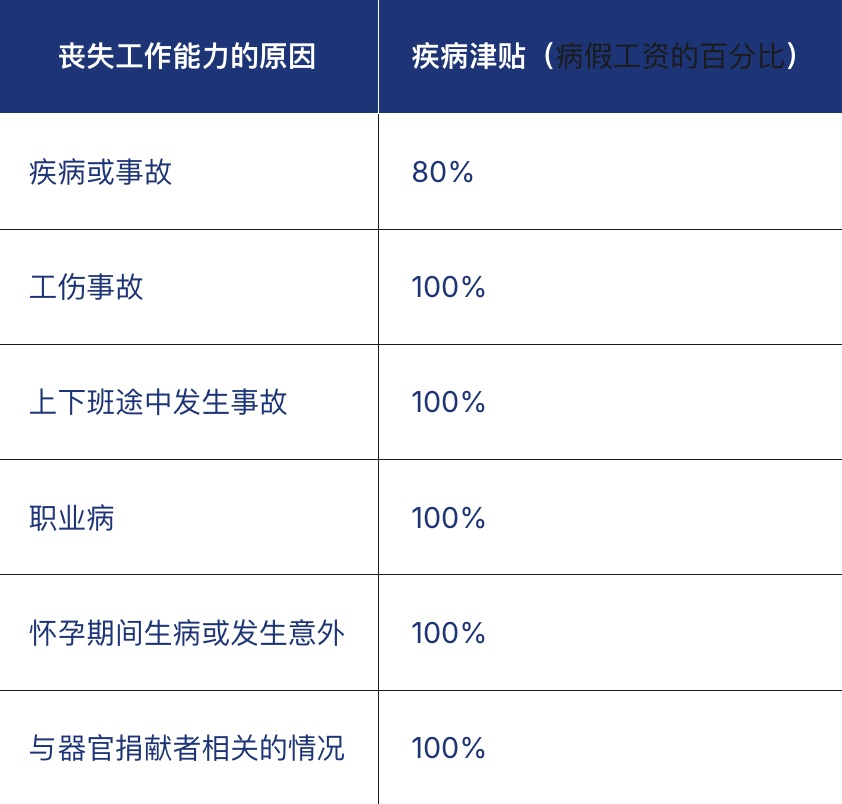
Sick Leave: Employees are entitled to a maximum of 182 days of paid sick leave. Employees who are sick during pregnancy are entitled to 270 days of sick leave. The employer pays the salary for the first 33 days. From the 34th day, paid sick leave is covered by the Social Insurance Institution (ZUS).
Sick – leave pay varies according to the degree of work incapacity.
Logic for Calculating Salary for Incomplete Attendance (including Absence or Unpaid Leave)
Expatriate Employees
Split Payroll
Local minimum wage required for work permits
Whether Local Social Welfare Can Be Withdrawn (e.g., Housing Provident Fund)
4. Dismissal Rules and Compensation Arrangements
Dismissal (Legal Requirements and Best Practices)
Notice Period: The minimum notice period is 2 weeks and will be extended according to the length of employment.
If the service period is less than 6 months, it is 2 weeks.
If the service period is more than 6 months, it is 1 month.
If the service period is more than 3 years, it is 3 months.
Notice period during the probation period:
If the probation period is a maximum of 2 weeks, it is 3 days.
If the probation period is more than 2 weeks but less than 3 months, it is 1 week.
If the probation period is 3 months, it is 2 weeks.
Voluntary Resignation: Employees are allowed to resign at any time according to the employment agreement.
Reason: No legal requirement.
Compliance requirement: Employees must submit a written resignation letter signed with ink or an electronic/digital signature.
Statutory notice period:
Depends on the employee’s service period:
Less than 6 months of service: 2 weeks’ notice in advance.
More than 6 months of service: 1 month’s notice in advance.
3 years of service: 3 months’ notice in advance.
Severance pay: No legal requirement.
Final payment due: Termination date.
Dismissal during Probation: Employers are allowed to terminate the employment relationship at any time during the probation period.
Reason: Although there is no legal requirement, employers should still state the reason for dismissal to avoid possible legal claims from employees.
Statutory notice period:
If the probation period is up to 2 weeks: 3 working days.
If the probation period is more than 2 weeks but less than 3 months: 1 week.
If the probation period is more than 3 months: 2 weeks.
Severance pay: No legal requirement.
Final payment due: Termination date.
How to notify employees: Written notice signed with wet ink or QES.
Negotiated Dismissal: Employers and employees are allowed to mutually agree to terminate the employment relationship for any reason.
Common reasons:
There may be disputes or lawsuits involving the employee.
Employees cannot be dismissed without just cause.
The employee has negotiated the termination of the contract with the client.
Statutory notice period: Mutually agreed upon, no legal requirement.
Severance pay:
Yes, it must be paid. The amount must be higher than the legal requirement to encourage employees to sign the mutually agreed – upon termination agreement. This severance pay is usually an additional 1 or 2 months’ salary on top of the statutory severance pay*, calculated as follows:
Less than 2 years of service: 1 month’s salary.
2 – 8 years of service: 2 months’ salary.
8 years of service: 3 months’ salary.
*Usually only required when the contract is terminated without the employee’s fault.
Final payment due: Termination date.
Termination of Employment due to Lay – off or Other Business Reasons: Employers are allowed to dismiss employees due to lay – off or other business reasons.
Reason: Reorganization, lay – off, budget reasons, or downsizing.
Statutory notice period:
Depends on the employee’s service period:
Less than 6 months of service: 2 weeks’ notice in advance.
More than 6 months of service: 1 month’s notice in advance.
3 years of service: 3 months’ notice in advance.
Severance pay:
If it is due to reasons unrelated to the employee, the employee will be entitled to severance pay based on their service period.
Less than 2 years of service: 1 month’s salary.
2 – 8 years of service: 2 months’ salary.
8 years of service: 3 months’ salary.
Final payment due: Termination date.
How to notify employees:
The termination notice must be delivered to the employee in writing.
The signature can be in wet ink or QES.
Dismissal for Just Cause: Employers are allowed to dismiss employees for intentional misconduct.
Reason:
The employee seriously violates their basic employee duties.
During the employment contract period, if the criminal facts are clear and the employee is unable to continue working, or if the criminal circumstances are serious and the case is ruled not to be accepted by the people’s court, people’s procuratorate, or prosecution agency in accordance with the law.
Due to the employee’s fault, the employee loses the necessary authorization to perform their duties.
Compliance requirement:
Employers must judge whether the employee’s breach of duty is serious (i.e., misconduct or serious misconduct) based on the degree of the employee’s fault and the risk of infringement on the employer’s interests.
An internal investigation may be required, and employees should be involved. They should even be given an opportunity to present their case before considering dismissal.
If an employee is found to have committed serious misconduct, immediate dismissal (i.e., dismissing the employee immediately without prior notice) will be triggered. However, this should always be a last resort.
If an employee is found to have misconduct, the employer can dismiss the employee but must provide an appropriate notice period.