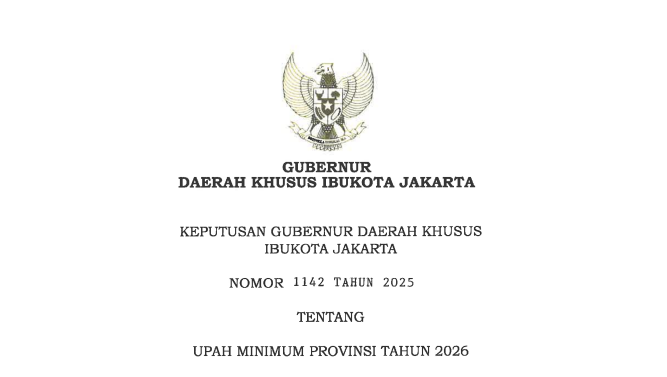
The Governor of the Special Capital Region of Jakarta has officially issued Decree No. 1142/2025, confirming that effective January 1, 2026, the Jakarta Provincial Minimum Wage (UMP Jakarta) will be adjusted to:
IDR 5,729,876 per month
This adjustment continues Jakarta’s multi-year trend of steadily increasing minimum wages. It also means that companies with operations or employees in Jakarta will need to recalibrate their payroll structures and compliance arrangements accordingly.
Based on the official policy text, SmartDeer has summarized the key changes and the implications enterprises should pay close attention to.
I. What Are the Direct Impacts of the Minimum Wage Increase?
An increase in the minimum wage affects far more than just base salary—it triggers adjustments across multiple employment-related areas:
1️⃣ Overtime Pay Will Increase Accordingly
Under Indonesian labor law, overtime pay is calculated based on an employee’s hourly wage, typically starting at 1.5x for regular overtime.
As the minimum wage rises, overtime costs will increase accordingly.
2️⃣ Social Security Contribution Bases Must Be Adjusted
The contribution bases for BPJS Ketenagakerjaan (Employment Social Security) and BPJS Kesehatan (Health Insurance) must not be lower than the local minimum wage.
Employers must update social security declarations and payroll deductions in line with the new standard.
3️⃣ Higher THR (Religious Holiday Allowance) Costs
Indonesia’s legally mandated THR (Religious Holiday Allowance) is generally calculated based on an employee’s salary.
With the minimum wage increase, overall THR expenses will also rise.
II. Practical Challenges for Employers Behind the Wage Increase
In practice, minimum wage adjustments often trigger a chain reaction rather than a simple salary update:
1️⃣ Structural Increase in Labor Costs
For labor-intensive industries such as manufacturing and retail, the wage increase may lead to an overall payroll cost rise of approximately 3%–8%, compounded by higher overtime and social security expenses.
2️⃣ Increased Compliance Risk
If companies adjust only base salaries while overlooking:
- Overtime pay calculations
- BPJS contribution bases
- THR payment standards
they may easily be deemed non-compliant during audits, employee complaints, or labor disputes.
3️⃣ Greater Difficulty in Managing Employee Expectations
Following a minimum wage increase, employees often raise expectations regarding:
- Benefits
- Overtime arrangements
- Bonus structures
Without clear communication, this may actually increase employee turnover risk.
III. Four Practical Recommendations for Employers
Before the new standard takes effect in 2026, companies are advised to prepare in advance:
① Verify Employees’ Actual Work Locations
Confirm whether each employee’s actual work location falls under the Jakarta Special Capital Region to avoid misapplying wage standards across regions.
② Recalculate Payroll Budgets
Go beyond base salary differences and factor in:
- Overtime multiplier effects
- Increases in social security contributions and THR
③ Communicate Early with Employees
Clearly explain changes in salary structure and distinguish between:
- Minimum wage adjustments
- Role-based or performance-based salary changes
to avoid misunderstandings.
④ Conduct an Employment Compliance Review
Pay special attention to whether updates are needed in:
- Salary clauses in employment contracts
- Overtime and social security calculation methods
- THR payment rules
Minimum wage increases reflect enhanced employee protection, while also raising the bar for corporate compliance and management precision.
Proactive planning and systematic adjustments are far more effective than last-minute, reactive responses.
For companies with ongoing employment arrangements in Jakarta or other parts of Indonesia, it is strongly recommended to complete a comprehensive payroll and compliance review early to reduce operational risks.
About SmartDeer
SmartDeer is a leading global one-stop HR compliance service platform, specializing in:
- Cross-border employment compliance
- Employer of Record (EOR/HRO) services
- Global payroll solutions
- Visa and immigration support
- HR SaaS systems
With coverage across 200+ countries and regions, and self-operated entities throughout Asia, North America, the Middle East, and Europe, SmartDeer delivers secure, efficient, and compliant workforce solutions for globally expanding enterprises.
Whether you are hiring overseas employees or managing multi-country HR compliance, SmartDeer safeguards your global business every step of the way.

📮 Scan the QR code to connect with a dedicated consultant and receive more policy insights & compliance guidance.
发表回复