According to official announcements from the Government of Kazakhstan, the new Tax Code will officially come into force on January 1, 2026.
This round of tax reform represents one of the most comprehensive systemic adjustments in recent years, covering key areas such as personal income tax, social tax, and tax administration mechanisms.
The overarching goal of the reform is to enhance tax fairness, standardize tax collection procedures, and strengthen the sustainability of the fiscal system through structural optimization and regulatory redesign.
For companies employing local staff or assigning personnel to Kazakhstan, these changes will have a direct impact on payroll structures and overall employment costs.
I. Personal Income Tax (IIT): From a Flat Rate to a Progressive Tax System
1️⃣ Introduction of Progressive Tax Rates
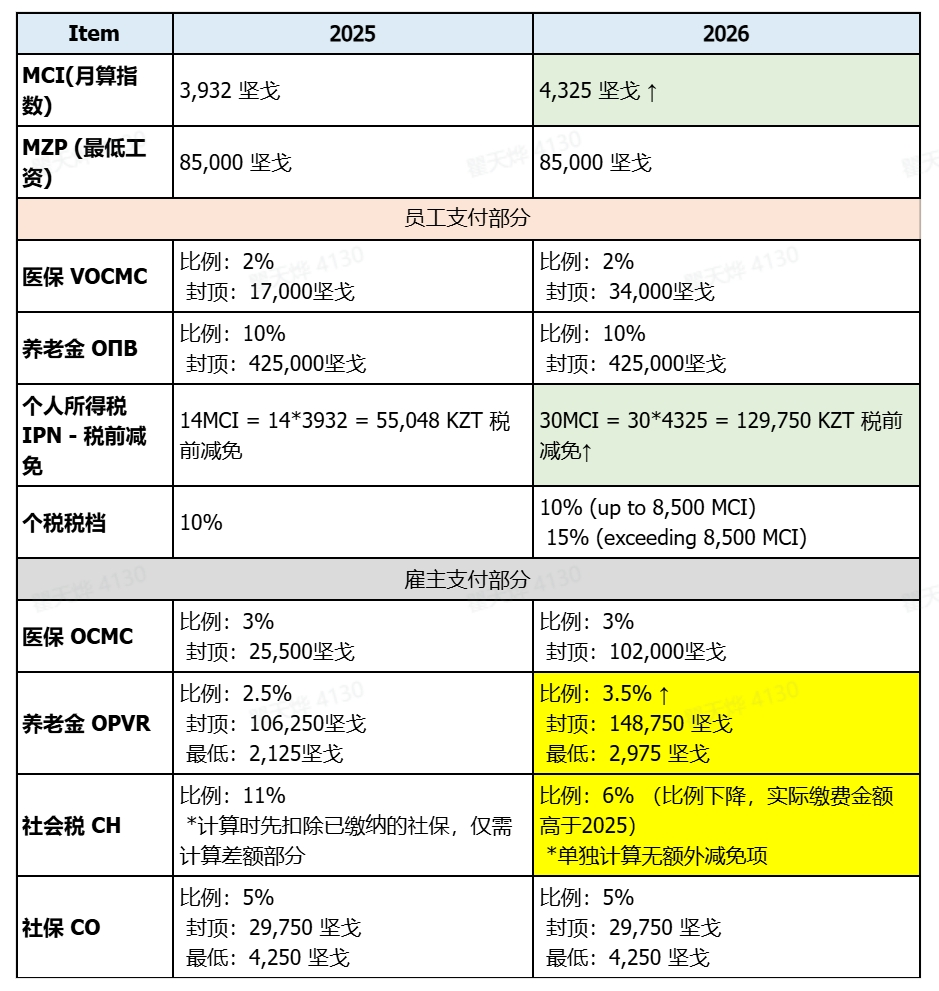
Starting in 2026, Kazakhstan will shift from a single flat personal income tax rate to a two-tier progressive tax system:
- Annual income ≤ 8,500 MCI: 10%
- Annual income > 8,500 MCI: 15%
This change will increase the overall tax burden for high-income earners and requires employers to pay closer attention to net income outcomes when designing compensation packages.
2️⃣ Optimization of Tax Deductions
Alongside the higher marginal rate for higher-income individuals, the new Tax Code also introduces adjustments to personal tax deductions: - Increase in the standard deduction
The previous standard deduction of 14 MCI has been replaced by 30 MCI, equivalent to approximately 129,750 KZT, significantly expanding coverage. - New social contribution deductions
Individuals may deduct the following social payments from taxable income: - Mandatory pension contributions
- Mandatory social health insurance contributions
- Social contributions made under service or labor contracts
These measures partially offset the increased tax burden and enhance social protection coverage.
II. Social Tax: Lower Rate, Removal of Offset Mechanism
1️⃣ Adjustment of the Social Tax Rate
Under the new Tax Code, the social tax rate will be unified and reduced to 6%, which at first glance appears to ease the employer tax burden.
2️⃣ Elimination of the Deduction Mechanism
However, it is important to note that the previously available policy allowing social tax to be offset by social contributions will be abolished.
As a result, despite the nominal reduction in the tax rate, employers can no longer deduct social contributions against social tax.
The actual cost impact must therefore be recalculated based on each company’s workforce structure and compensation model.
III. Practical Impact on Employers and Employees
For Employers - Payroll and compensation structures — particularly for mid- to high-income positions — will need to be reassessed
- The combined cost of social tax and mandatory social contributions must be recalculated
- Tax compliance and reporting requirements will become more granular, placing higher demands on HR–Finance coordination
For Employees - Low- and middle-income earners will be minimally affected by the progressive tax system
- High-income earners may experience an increase in tax burden
- Expanded social deductions contribute to improved social security and welfare coverage
IV. How Should Companies Prepare in Advance?
Companies are advised to focus on the following actions: - Run advance net-cost simulations
Model employer and employee costs under the new tax regime across different salary bands. - Review employment contracts and compensation structures
Ensure consistency between contractual terms and tax treatment to avoid compliance risks. - Strengthen HR–Finance collaboration
The coexistence of progressive tax rates and multiple deductions requires higher data accuracy and coordination. - Monitor implementing regulations
Certain operational details may be further clarified through secondary legislation or implementation guidelines.
Conclusion
Kazakhstan’s 2026 tax reform reflects a clear policy direction toward greater structural fairness and more standardized tax administration.
For employers, early understanding of the new rules and timely adjustment of internal cost models will be critical to ensuring a smooth transition.
SmartDeer will continue to monitor tax and employment policy developments in Central Asia and other key global expansion markets, helping enterprises advance localized operations under a compliant and sustainable framework.
About SmartDeer
SmartDeer is a leading global, one-stop HR compliance platform dedicated to supporting enterprises with: - Cross-border employment compliance
- Employer of Record (EOR) / HRO services
- Global payroll
- Visa and immigration support
- HR SaaS systems
With coverage across 200+ countries and regions and wholly owned entities throughout Asia, North America, the Middle East, and Europe, SmartDeer delivers secure, efficient, and fully compliant global workforce solutions.
Whether you are hiring overseas employees or managing multi-country HR compliance, SmartDeer safeguards your global expansion every step of the way.
发表回复